


If you are someone who always struggles whether your succulents are getting too much water or too little, then you should definitely consider trying the semi-hydroponic setup!
WHAT IS SEMI-HYDROPONIC?

Photo credit: plantcareforbeginners.com
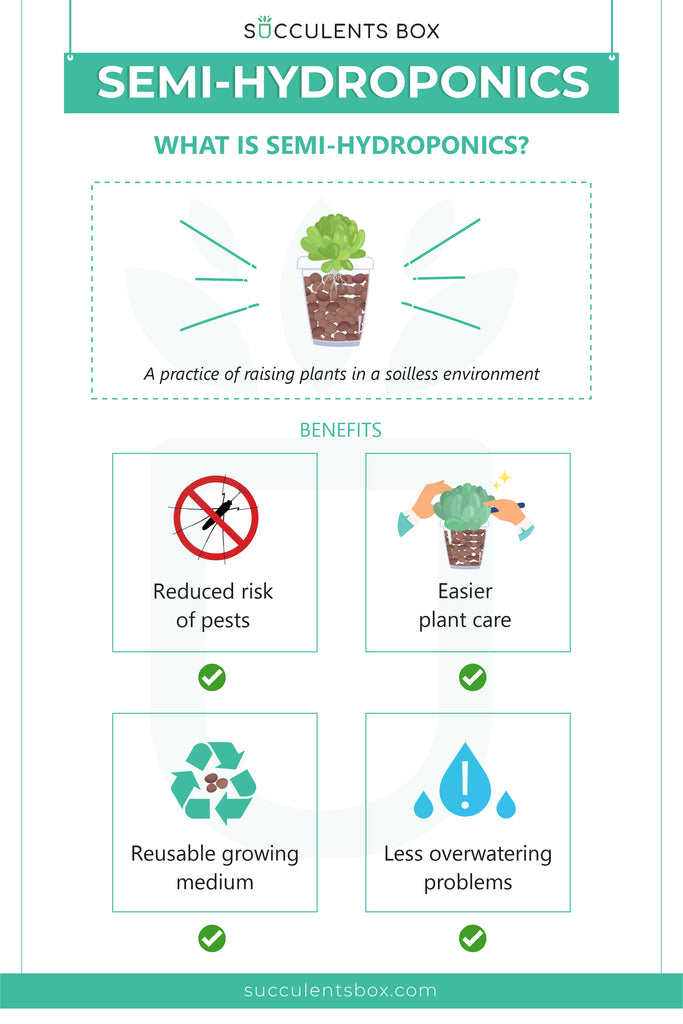
To make it simple, semi-hydroponics or also called passive hydroponics is a well-known practice of raising plants in a soilless environment, where it helps eliminate stress to your succulents as everything they need, like oxygen, water, and nutrients, are directly provided to their roots through a carefully crafted nutrient solution. Plus, it promotes good airflow to the plant's root system, making most succulents healthier and grow faster in this kind of setup.
HOW TO SETUP A SUCCULENT IN SEMI-HYDROPONICS
Setting up your succulents in a semi-hydroponic system is not difficult at all, nor is it expensive, but it does require a few more steps than traditional container gardening, like:
1. An appropriate container
To keep your plant's roots up out of the water, it's wise to choose a tall, narrow container, rather than a short, wide container. You can use a glass container for your succulents, but most prefer using a plastic one (like a cylindrical take-out container) as they are inexpensive, efficient, and easy to drill holes in. Furthermore, they have a lid, which you can use to maintain higher humidity.

2. Drilling two holes
Instead of drilling drainage holes of the base of the container, succulents in a semi-hydroponics setup need the holes on the sides to create a reservoir in the bottom that wicks fertilizer solution up through the growing media to the roots.

Photo credit: orchidboard.com
To do this, simply use a handheld drill to make 2 holes into your container's sides (1.5 to 2-inches high from the bottom).
3. Prepare your growing medium.
Lightweight expanded clay aggregates, or also known as LECA, are the most commonly used growing medium for this type of setup. They are porous and will wick water from the reservoir in the bottom upwards to the roots. Furthermore, LECA is inexpensive and can be reused.

Before potting your succulents, you first need to rinse your LECA pellets with clean water until you no longer see orange-ish particles coming off of them. Soak them in freshwater for about 30 minutes, then rinse them again for the last time. Put your LECA pellets into your container until it's 3 quarters filled.
4. Transplant your Succulent
This is the most challenging part of the process. To begin, carefully take your succulent out from its container, while making sure not to break off or damage any roots. Using your fingers, gently remove as much of the potting soil as possible from the roots. Once the majority of the growing medium has been removed, rinse it lightly by putting it under a faucet to remove any remaining soil.
Place your plant in the container and add more LECA around the roots until the container is full. Make sure to fill in any gaps by shaking the pot periodically for the pellets to settle.
5. Cut a hole in your container’s lid
The final step is to cut a slit and a hole in your container's lid using a pair of scissors or a box cutter. This will allow higher humidity levels within the container, and at the same time, prevent the water from evaporating quickly.


CARING FOR YOUR SUCCULENT IN SEMI-HYDROPONIC SETUP
1. Once your semi-hydroponic setup is complete, watering your succulents becomes much simpler. In general, depending on the ambient humidity and heat in your area, you will need to water your succulent at least once every 1 to 2 weeks.
2. When the container is dry, set it in the sink or bathtub and rapidly fill the container using a fertilizer solution diluted to one-quarter to one-half the recommended strength until it reaches the top. Doing this will saturate the medium and refill the reservoir as the solution drains down to the level of the drain holes.
3. Every four weeks, you will need to flush the LECA pellets with clean water to rinse out any accumulated salts before adding any fertilizer solution.
4. You can place your semi-hydroponic succulents inside your house near a window that provides adequate lighting, or even outside. In case it rains, it will drain out the drainage holes. This may change the fertilizer solution's actual concentration, but this is okay for short periods.


BENIFITS OF SEMI-HYDROPONICS SETUP
Growing in a semi-hydroponics setup is an ideal environment for succulents as long as you follow the correct way of transitioning them from soil or cutting to LECA.
Here are some of the benefits of growing your succulents in LECA:
- Reduced risk of pests
- Easier plant care
- Reusable growing medium
- Less overwatering problems
BOTTOMLINE
Give It Time! After the initial transplant into the LECA, you might not see much growth in your succulents for about one month, as it adapts to the new environment. But once you start seeing new roots develop, your plant’s growth will rapidly take off as long as it's getting the appropriate amount of light it needs. Furthermore, a semi-hydroponics system is surely an alternative way and the future of growing plants sustainably!
SEE MORE ABOUT HOW TO DRILL A DRAINAGE HOLE

Check out this quick video to see How to grow succulents in LECA
For Types of Succulents Careguide. Read more information here.
And get a free plant when your friends make an order. Sign up here!
Learn more about how to nurture and enjoy many gorgeous succulents and clever decoration tips with our newsletter. Sign up now!


